








We are entering one of the most consequential expansions of the electrical system in generations. Data centres, electrification, renewable generation, grid modernization, electrification of transportation and the reindustrialization of North America are pushing electricity demand to levels that would have seemed extraordinary only a decade ago. This increase would potentially double the electricity demand in the next 25 years.
At the same time, transformer manufacturers are being asked to improve efficiency, reduce losses, shorten lead times, control costs, and dramatically increase capacity.
We need to build more and build better.
But there is an important reality behind this energy transformation. We can only build what our supply chains upstream allow us to build.
We can only build what our supply chains upstream allow us to build.
That makes critical materials and transformer components much more than a procurement issue. It makes them a strategic issue.
Across North America, more than $4 billion of transformer OEM investments have been announced in recent years. Yet investment into the critical materials and components that will feed those factories is not keeping pace. We risk expanding our ability to assemble transformers while becoming increasingly dependent on imported electrical steel, cores, bushings, insulation and other critical components.
That is not supply-chain resilience. It simply moves the bottleneck upstream.
Electrical steel illustrates the challenge. Grain-oriented electrical steel (GOES) has been fundamental to transformer design for decades. Higher-performing grades, domain refinement, improved core designs and manufacturing processes have steadily reduced losses. Amorphous metal (AM) is becoming increasingly important as efficiency requirements rise. However, today North American production of GOES is roughly 50% of domestic apparent consumption, lower for highest grade demand..
Too often, however, we frame the discussion as a competition: GOES, Hi-Grade GOES, or amorphous? Which material wins? We’re asking the wrong question.
Different transformer applications, loading profiles, cost targets, designs and manufacturing environments require different solutions. The next generation of transformers will likely depend upon our ability to intelligently deploy multiple materials and types of technologies.
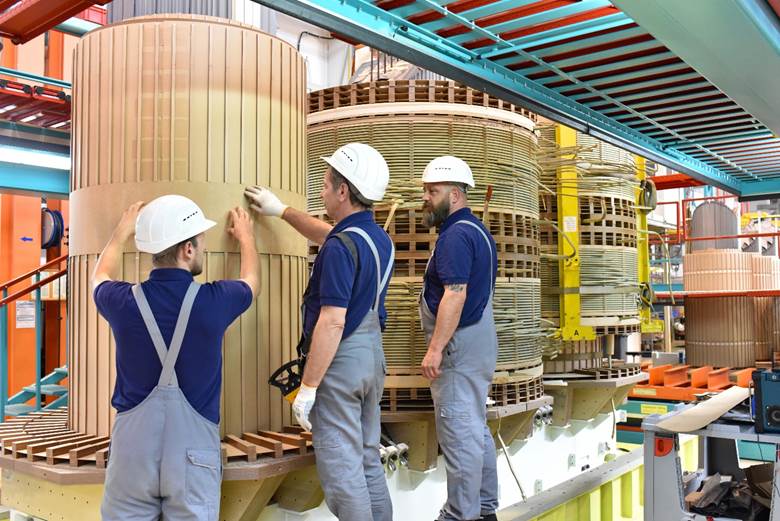
As transformer efficiency standards become increasingly demanding, higher-performance electrical steels are becoming essential to next generation transformer designs. Yet their value extends far beyond reducing core losses, creating opportunities to rethink transformer design, optimize material utilization, and deliver greater overall performance.
Material selection increasingly becomes part of optimizing the entire transformer, not simply one component. However, performance is only one dimension of next-generation transformer design. We must also design for availability, scalability, and resilience.
For decades, Western industry became extraordinarily good at optimization. We reduced inventory, consolidated suppliers, drove down purchasing costs, removed excess capacity and moved production to lower-cost regions of the world. Those disciplines created enormous value in relatively stable markets. Optimization and resilience, however, are not the same thing.
A supply chain optimized around lowest cost and minimum inventory can become very vulnerable when demand accelerates, trade relationships change or critical materials become constrained. A supply chain becomes particularly vulnerable when strategic components become concentrated in countries whose geopolitical interests may not be aligned with our own.
China is important to this discussion. Over several decades, China has built enormous capacity across electrical steel, transformer components and other materials essential to the electrical economy––accounting for more than 60% of combined global GOES/AM production today. Some of that capacity benefits from economic conditions different from those facing market-based Western producers, including state support, industrial policy, and other non-market factors. The resulting economics can make Chinese materials highly competitive in the short term, while making investment in new North American capacity considerably more difficult to justify.
This creates a paradox: the lowest-cost purchasing decision manufacturers make today can undermine the investment required to grow a resilient supply chain tomorrow.

We need to change our focus on suppliers to supply chains. A supply chain is an interconnected system of raw materials, processing, technology, manufacturing capability, capital investment, people and relationships that is often developed over decades. A supplier can be changed, but a strategic supply chain cannot simply be replaced when a shortage occurs.
Right now, parts of this industry are being asked to make enormous investments. A steel producer considering new electrical steel capacity, an amorphous-metal producer expanding production, or a component manufacturer installing new equipment all face the same fundamental questions:
Customers understandably want capacity before committing volume. Suppliers understandably want commitments before investing billions of dollars. But there is an additional question: will those investments be expected to compete against imported products from non-market economies at heavily discounted rates tomorrow?
Someone eventually must make the first move.
Next generation of transformer technology requires more than innovative engineering: It requires a new level of collaboration among utilities, OEMs, component manufacturers, material producers and governments.
This does not mean abandoning competition, closing markets or attempting to manufacture every transformer component domestically. North America cannot and probably should not do everything itself. By understanding which capabilities are strategically critical, where domestic capacity is necessary, and where partnerships with trusted market-economy allies like Japan and Europe can provide the scale, manufacturers can make informed decisions that reduce geographic and geopolitical risk.
Resilience does not require self-sufficiency. It requires avoiding strategic dependence.
Resilience does not require self-sufficiency. It requires avoiding strategic dependence. The transformer industry has always been a building industry. We build equipment expected to operate for decades. We build factories, technologies, skills and relationships that take years to develop. Now we must build something larger, the industrial ecosystem capable of supporting the next generation of the electrical grid, and fast.
The greatest risk may not be that we invest too early. It may be that we build the transformer factories, create the demand, and then discover that we failed to build and defend the supply chains required to feed them.
Suppliers compete. Supply chains win.

Ron Harper, P.Eng, C.Dir.
Strategic Advisor
Ron Harper is a strategic advisor and former President and CEO of JFE Shoji Power Canada, with over 35 years of experience in manufacturing, engineering, operations and executive leadership. He has served on numerous industry and community boards, including as Chairman of the Association for Manufacturing Excellence. His work focuses on next-generation manufacturing, sustainable industrial practices and clean energy policy. He is also a member of the APC Media Executive Editorial Board.

This article was originally published in the October 2026 issue of the Next-Gen Infrastructure & the Digital Grid magazine.
View Magazine