







From Engineering Blueprint to Lifecycle Asset Intelligence
Building the foundation for smarter grid operations through engineering accuracy, post-construction verification, and continuously validated asset intelligence.
Electric transmission infrastructure is entering a period of unprecedented complexity. Aging assets, increasing electrical demand, renewable energy integration, wildfire mitigation requirements, and heightened regulatory scrutiny are forcing utilities to rethink how they manage transmission systems. At the same time, these assets are expected to remain in service for decades, even as operating conditions and the information surrounding them continue to change.
Historically, transmission assets have been managed through a combination of engineering drawings, Geographic Information System (GIS) records, maintenance logs, project closeout packages, field inspections, and the institutional knowledge of experienced personnel. Each source can be useful, but together they often leave a fragmented picture. Engineering drawings become outdated after construction. Asset records reside in separate platforms. Repairs, material substitutions, vegetation encroachments, and field modifications may be documented inconsistently. Utilities can discover the gap between what the records say and what exists in the field only after a new project begins or an operational issue occurs.
Digital twins offer a way to close that gap. In the transmission context, a digital twin is far more than a 3D visualization or digital archive. It is a continuously validated representation of a physical asset that connects engineering design data, geospatial information, field verification, operational conditions, and lifecycle maintenance records. Properly implemented, it becomes a trusted decision-support environment for engineering, operations, maintenance, compliance, and capital planning.
The central idea is simple: the value of a digital twin does not come from creating a digital copy. It comes from aligning teams around a verified understanding of the asset. That journey begins with design intent, is tested against construction reality, and becomes materially more valuable once post-construction verification establishes a defensible baseline for the years ahead.

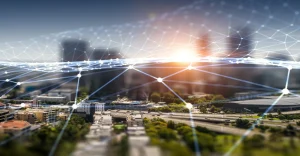
(Transmission Lines at Sunset, courtesy Brenda Steinert, Davey Resource Group, Inc.)
Defining the Transmission Digital Twin
A transmission digital twin can be understood as a verified virtual replica of physical infrastructure that reflects both intended design and real-world condition. Towers, poles, conductors, insulators, hardware, clearances, terrain, and vegetation can all be represented in a highly accurate digital environment. Unlike a static GIS layer or legacy drawing, the twin is designed to evolve as the physical system evolves.
That distinction matters. GIS records may provide asset locations and attributes, while engineering drawings capture detailed design intent. Neither, by itself, guarantees that the current record matches the field. A digital twin bridges that gap by combining engineering models with geospatial information, LiDAR, aerial imagery, inspection records, asset databases, and, where appropriate, operational and environmental data streams.
LiDAR and 3D photogrammetry are especially valuable because they can capture three-dimensional geometry such as conductor sag, terrain profiles, structure locations, and vegetation proximity with high precision. High-resolution aerial imagery adds visual context. AI-enabled field verification platforms can standardize image capture, identify defects or anomalies, geotag observations, and preserve auditable evidence. Together, these layers create a multidimensional model that can support engineering analysis, maintenance planning, compliance reporting, operational optimization, and future design. The twin becomes useful because it’s not only designed, it’s also verified.
The Engineering Foundation: PLS-CADD and Design Accuracy
Every effective transmission digital twin begins with an accurate engineering model. For overhead transmission systems, PLS-CADD is a foundational platform for developing the geometric and electrical blueprint of a line. The model defines structure placement, conductor characteristics and behavior, clearances, loading conditions, and expected operating performance.
Before construction, engineers use these models to evaluate conductor sag and tension, structure loading, ground and vegetation clearances, constructability challenges, and other conditions that can affect reliability and project execution. Identifying problems in design is substantially more efficient than discovering them in the field, where changes can trigger rework, schedule impacts, and additional cost.

(PLS-CADD Platform, Courtesy Davey Resource Group, Inc.)
In this sense, the engineering model represents the idealized asset: the line exactly as it was intended to be built. It is the natural starting point for a digital twin because every subsequent dataset can be compared against that engineering intent. The stronger the initial model, the more useful those comparisons become. An outdated or poorly developed model introduces uncertainty that can cascade through inspection, analysis, maintenance, and upgrade planning. A precise model that is continuously validated against field conditions, by contrast, becomes a durable foundation for long-term asset intelligence.
Field Verification: Closing the Gap Between Design and Reality
Construction rarely unfolds perfectly and deviations are not unusual. Field conditions change, material substitutions occur, structure locations vary from plan, and hardware may be installed differently than anticipated. Many of these differences are small, but even modest changes in attachment points, conductor geometry, or structure configuration can affect clearances, loading assumptions, maintenance requirements, and long-term performance.
The challenge is not that deviations occur, it’s that utilities can lose visibility into those changes after a project is energized. Traditional as-built documentation, selective inspections, and closeout packages provide important records, but they do not always create a comprehensive, auditable representation of actual field conditions.
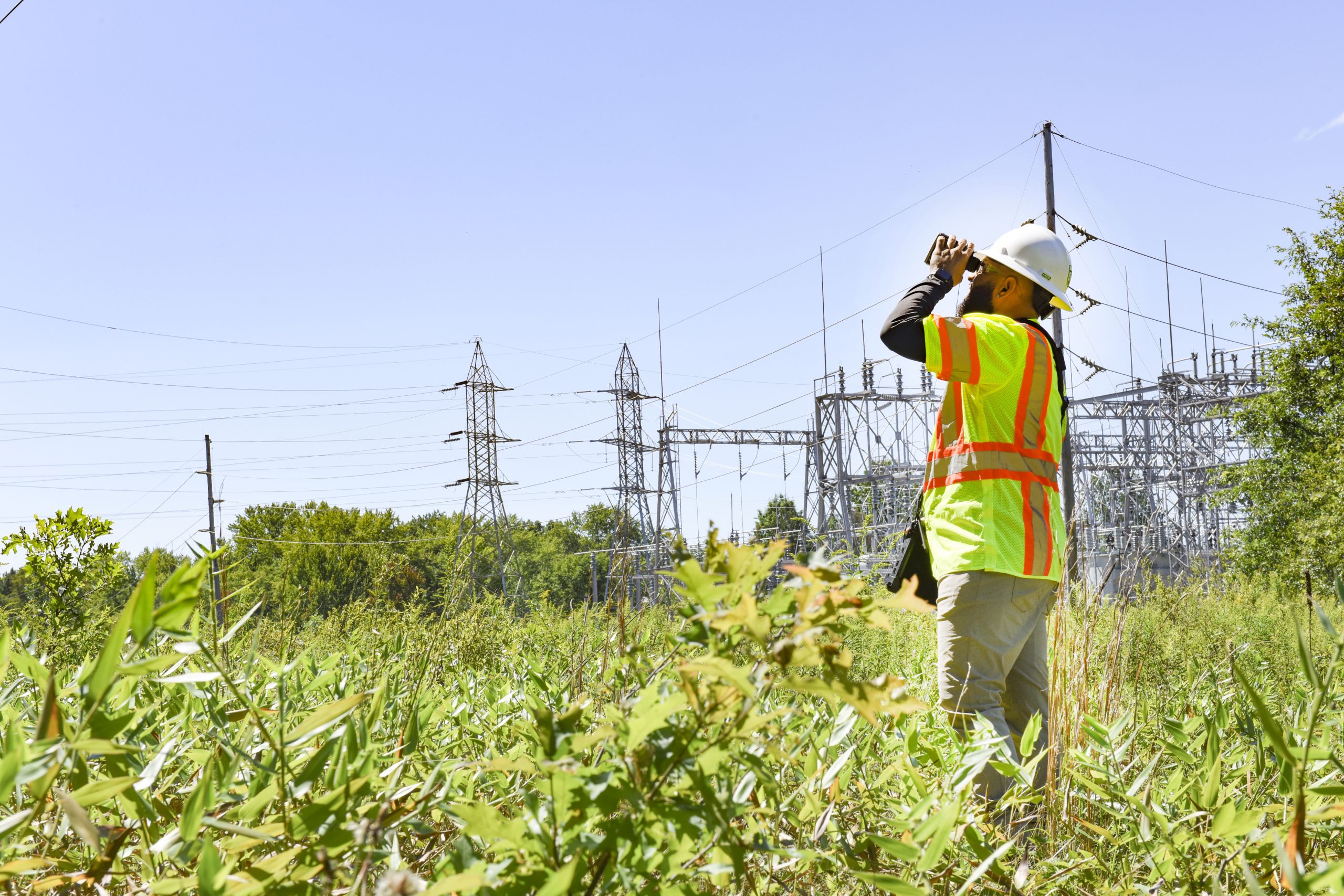
Modern verification technologies can make that process more systematic. Aerial imagery and inspection platforms using high-resolution photogrammetry or LiDAR to produce point cloud workflows allow engineers and inspectors to compare design intent directly with physical reality. Structure configurations, hardware installation, conductor attachment details, clearances, material discrepancies, construction defects, and asset inventory can be documented in a standardized digital record rather than scattered among handwritten notes and isolated photographs.

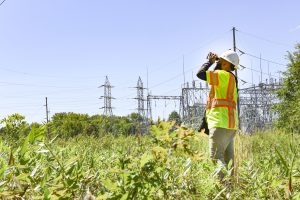
(Field data capture with photogrammetry point cloud device, courtesy Davey Resource Group, Inc.)
This validation layer is what transforms a design model into a trusted asset model. By connecting verified as-built conditions back to engineering intent, utilities establish traceability that can support future maintenance decisions, regulatory audits, upgrade projects, and investigations. Just as importantly, modern field verification can shorten the time between construction and validation. Rather than waiting for fixed-wing LiDAR acquisition and processing to identify potential discrepancies, field-based inspection platforms can provide actionable information while construction crews are still onsite, allowing issues to be identified, evaluated, and corrected before demobilization. These platforms can also organize standardized, geotagged field imagery and inspection evidence so that observations remain tied to specific assets and conditions over time.
Establishing the Asset Condition Baseline
One of the most important moments in the life of a digital twin occurs immediately after construction or a major asset modification. It is also one of the steps most vulnerable to schedule pressure and budget constraints: establishing a comprehensive, verified condition baseline.
Without that baseline, utilities may struggle years later to determine which components were originally installed, whether a defect existed at energization, whether a modification occurred later, or how quickly a condition has changed. A clearance issue or structural concern may be visible in the present without a reliable record of when it first appeared. The digital model may be sophisticated, but the historical context remains uncertain.
A standardized post-construction baseline changes that. By capturing LiDAR, imagery, and inspection data at the point when operational responsibility begins, the utility creates a defensible snapshot of the asset. Future inspections, maintenance events, and engineering analyses can then be compared against a known starting condition.
This improves the quality of decision-making. Instead of relying solely on conservative assumptions, engineering and asset management teams can work from measurable field intelligence. They can see not only what an asset looks like now, but how it is changing. That continuity is where the digital twin begins to compound in value.
From Static Records to Operational Intelligence
Once a verified baseline exists, a digital twin can support operational applications that improve both reliability and economic performance. Dynamic Line Rating (DLR) is one of the clearest examples. Traditional ratings are often based on conservative assumptions about weather and operating conditions. A digital twin that integrates conductor geometry with relevant operational and environmental data can support more accurate assessments of conductor temperature, sag, and available capacity, helping utilities make better use of existing infrastructure when conditions permit.
Vegetation management is another important application. NERC FAC-003 is intended to reduce the risk of transmission outages caused by vegetation encroachment. By combining LiDAR-derived vegetation models with conductor geometry and sag analysis, utilities can evaluate clearance risk with greater precision and prioritize work where conditions warrant attention rather than relying only on broad assumptions or periodic observations.

(LiDAR Image Capture, courtesy Davey Resource Group, Inc.)
The same verified framework can strengthen sag and tension analysis, conductor condition assessment, structural performance analysis, asset risk modeling, and predictive maintenance planning. Standardized inspection data makes deterioration easier to trend across time and across a large network. AI-supported inspection workflows can further help identify recurring defects or anomalies that may be difficult to consistently recognize at scale.
The result is a shift from reactive maintenance toward proactive asset management. Instead of waiting for a failure or a field discrepancy to force action, utilities can use changes in verified asset conditions to identify emerging risk, prioritize intervention, and focus resources where they are most likely to improve reliability.
Regulatory and Financial Drivers
The growing interest in digital twins is not driven by technology alone. Regulatory and financial pressures are increasing the value of reliable, auditable asset information. Transmission owners are being asked to demonstrate that existing infrastructure is being operated efficiently, that maintenance and compliance decisions are defensible, and that capital investments produce measurable system benefits.
Digital twins provide an analytical and documentation framework for those discussions. Verified asset records can strengthen compliance audits, capital planning justification, formula-rate recovery documentation, rate-case support, and asset investment prioritization by connecting decisions to traceable field evidence and engineering analysis.
That traceability matters when regulators, auditors, insurers, or other stakeholders ask why a particular investment was made or how a risk was evaluated. Fragmented spreadsheets, disconnected drawings, and incomplete inspection files can make even sound decisions difficult to defend after the fact. A continuously maintained digital asset record gives utilities a more coherent evidentiary foundation. In that sense, the digital twin becomes not only an engineering tool, but a business asset.
The Lifecycle Advantage
Transmission infrastructure operates on long horizons. Assets installed today may remain in service for several decades, which makes point-in-time solutions increasingly inadequate. The greatest value of a digital twin appears when each stage of the asset lifecycle contributes to a continuous information loop rather than generating a new, disconnected set of records.
Pre-construction surveys inform engineering design. Engineering models establish design intent. Construction quality assurance documents how the asset is installed. Post-construction verification establishes the baseline. Operations and maintenance add new observations, while future renewals and upgrades build on the record rather than starting over. Each phase contributes information while maintaining continuity with the phases before it.
Over time, that continuity can reduce repeat field visits and redundant data collection, improve engineering accuracy, support more targeted maintenance investment, and reduce the need to rely on unnecessarily conservative assumptions when actual conditions can be measured. Future rebuilds and upgrades can begin with decades of accumulated asset intelligence rather than incomplete records assembled at the start of a new project.
Most importantly, the digital twin evolves alongside the physical asset. Its value grows as verified information accumulates, shifting infrastructure management from reactive problem-solving toward proactive, evidence-based decision-making.
Digital twins represent a fundamental shift in how electric transmission infrastructure can be managed. Their value does not come from visualization alone. It comes from connecting engineering intent, construction reality, operational performance, and lifecycle asset management within a single verified framework.
The progression is clear: engineering models establish the blueprint, construction delivers the asset, post-construction verification validates reality, and ongoing inspection and operational data transform that verified information into lifecycle intelligence. For utilities seeking to modernize transmission operations, the critical question is not simply whether a digital twin exists. It is whether the underlying asset information can be trusted.
Organizations that establish defensible post-construction baselines and maintain those records over time create a stronger foundation for engineering, maintenance, compliance, and investment decisions. Those that skip verification risk building sophisticated digital models on uncertain assumptions.
For decades, Davey Resource Group, Inc. has worked with electric utilities across the planning, design, inspection, verification, and management of critical infrastructure, drawing on the experience of hundreds of engineers and designers. That multidisciplinary perspective reinforces a practical lesson for digital-twin programs: technology creates the greatest value when accurate engineering, repeatable field verification, and lifecycle asset intelligence are connected from the beginning. As the transmission grid becomes more complex, the organizations that maintain that connection will be better positioned to make successful and informed decisions well into the future.

Jay Foringer is Market Manager for Davey Resource Group’s Transmission & Substation Engineering team. In his role, Jay expands Davey’s current asset management operations into the transmission and substation space by strengthening existing relationships with electric utilities. With industry experience going back to 2001, Jay spent half of his career in engineering positions supporting substations and fossil fuel generation, as well as leadership roles.

Frank Noori is Director of TLine Engineering at Davey Resource Group and has more than 25 years of experience in transmission and distribution line engineering. He currently manages a team of over 150 transmission engineers. Frank has led large-scale utility projects and multidisciplinary engineering teams in the U.S. and internationally, with expertise spanning transmission line design, program and project management, and technical leadership. He has extensive experience with the PLS-CADD software suite and has trained and mentored hundreds of transmission engineers and designers in its use, helping advance industry knowledge and best practices.

Brenda Hite joined Davey in 2024 as a Senior Project Manager supporting Utility Asset Management Marketing. In her role, she works closely with Davey Resource Group’s utility asset management development team, providing project coordination and marketing support to advance solutions for the utility industry.
To learn more about Utility Asset Management services offered by Davey Resource Group, visit www.daveyresourcegroup.com

This article was originally published in the October 2026 issue of the Next-Gen Infrastructure & the Digital Grid magazine.
View Magazine