









A windstorm moves through a rural stretch where a distribution line runs for miles across heavily forested and hilly terrain. In the early hours, a limb falls and rests precariously on an energized conductor somewhere along that stretch. A recloser trips on the fault current spike, exactly as designed, and SCADA registers a deenergized section at the control center. What operators know at that precise moment is limited. All they know is that a section went dark, but they don’t know its location or cause, nor do they have any information about specific field conditions.
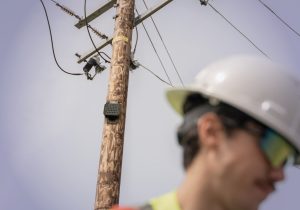
That gap is what Active Grid Response (AGR) was built to close. AGR is grid monitoring technology that includes a series of sensors housed in a sturdy, independently powered, power-pole-mounted enclosure that continuously monitors physical, electrical, and environmental conditions. Reclosers and SCADA only confirm a fault occurred, tripping and reporting exactly as engineered. AGR continues to report on the physical infrastructure during the outage and the conditions that triggered the trip. This type of technology is driving utilities to focus on improving grid resilience through more effective condition monitoring.
A Grid Facing More Frequent Stress
NOAA’s Climate Prediction Center now puts the odds near 70 percent that the current El Niño will become the strongest event on record for the 2026-2027 winter season. For utilities, this type of forecast translates directly into increased field exposure.
Today, distribution equipment faces heat, vibration, moisture intrusion, and debris impacts at levels that increasingly exceed original design tolerances, or has simply degraded after decades in service. Monitoring hardware installed to track those conditions carries the same exposure. A sensor unit that fails during the storm it was deployed to monitor provides no more insight than the SCADA system it’s intended to supplement.
Equipment and durability requirements vary by region, based on the weather and physical conditions a utility’s territory is expected to face. The National Electrical Safety Code divides the country into wind- and ice-loading districts, and a utility spanning a hurricane-exposed coastline and a high-elevation corridor prone to ice loading needs hardware specifications suited to each.
The average utility distribution pole in the United States is several decades old, installed well before the realities of current load demands. Much of the supporting hardware–crossarms, connectors, and the poles themselves–was engineered for a different era of electricity use.
Electrification, EV charging, and data center growth are adding new stress patterns to circuits that were never sized for this level of demand.
Rising customer demand pushes older conductors and hardware closer to their operating limits, straining circuits that weren’t built for this load. Aging infrastructure paired with rising load places greater physical stress on equipment designed for lower demand.

Hazard Awareness Delay Extends Every Outage It Touches
Hazard awareness delay measures the gap between when a hazard develops on the grid and when operators have enough information to understand what happened and where it occurred. Every hour spent locating a fault extends the outage duration and increases the odds that a manageable event becomes something worse.
Traditional monitoring tracks voltage and current. It confirms that something failed, but rarely says where the problem is or what created it. During major storms or wildfire conditions, when multiple faults can occur across a service territory at once, the delays compound, stretching crews thin as they cover ground to locate the faults and restore power.
Closing the delay is central to how utilities plan for resiliency.
Every hour spent locating a fault extends the outage duration and increases the odds that a manageable event becomes something worse.
Why Durability Drives AGR’s Resiliency Value
AGR’s value holds only if the hardware survives the harsh events it is built to detect. Electromechanical sensors mounted to poles, called Gridscopes, a core component of an AGR deployment, use solar power to remain operational through outages or physical damage to the pole itself. A device that loses power at the same moment the grid does offers no more visibility than the protective equipment it was meant to supplement.
AGR’s value holds only if the hardware survives the harsh events it is built to detect.
A limb resting on a covered conductor can go undetected electrically while still posing a safety or reliability risk. A vehicle strike can tilt a pole while the line remains energized, with automated operating equipment showing no issues. Weather-hardened Gridscopes detect mechanical contact and unnatural pole tilt across all conductor types, mitigating reliability and fire risks associated with these events.

Deployed across a service territory, these sensors create an early-detection network. Continuous monitoring catches issues before an outage occurs, and hardware that survives a fault can still report its exact location. Faster location and hazard information means less time patrolling during storm events or unplanned outages, and dispatchers know whether a hazard is stable or worsening before utility first responders leave the yard. Reduced patrol time benefits crews directly, and the safety gains extend to the communities the utilities serve.
Utilities evaluating AGR should treat durability as a baseline requirement rather than a feature. Its resilience depends entirely on hardware that continues to function under harsh conditions. The utilities best positioned to deal with aging infrastructure and confront the increasing number of extreme weather events will be those that demand durable hardware from the start.


Tim Bedford is a Principal Customer Success Manager at Gridware, brings 36 years of frontline utility experience to the role. He began his career as a Journeyman Lineman at Pacific Gas and Electric Company, advancing to senior leadership positions in Safety, Operations, Compliance, and later Principal Program Manager for Enhanced Powerline Safety. Bedford first encountered Gridware’s Active Grid Response technology in 2023, when he was tasked with validating it or failing it before PG&E would deploy it. He joined Gridware in 2025, convinced that the technology could change the industry by improving safety and reliability for employees and the public.
He now helps Gridware & utilities advance their system monitoring capabilities to close the Hazard Awareness Delay, enabling Active Grid Response that puts linemen at risk in the field.

This article was originally published in the October 2026 issue of the Next-Gen Infrastructure & the Digital Grid magazine.
View Magazine