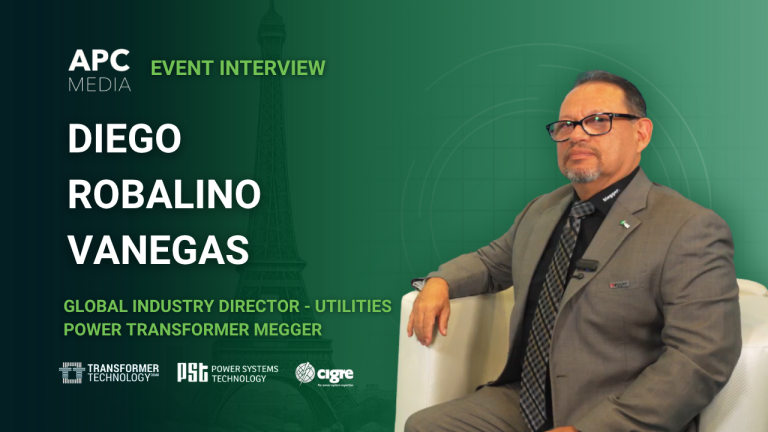










Why Collaboration Matters in the LPIT Ecosystem | Andrea Bonetti, Megger & Petri Hovila, ABB
According to Andrea Bonetti of Megger and Petri Hovila of ABB, low-power instrument transformers (LPITs) are proven, available and now standardized, with ABB’s first sensor products dating back to 1992. The remaining barrier is human rather than technical: many utilities cannot find commissioning engineers who are comfortable testing protection relays connected to LPITs. Their joint paper argues that relay and test equipment makers should validate the whole measurement chain together.
Recorded live at CIGRE 2026 in Paris.
What You Will Learn
- How LPITs differ from traditional current and voltage transformers
- Why IEC 61850 process bus went from “added complexity” to a problem solver
- Why total accuracy across the whole measurement chain matters more than any single component
- Which IEC technical committees cover the chain
- Why testing and commissioning is now the last barrier to wider LPIT adoption
Meet the Experts: Andrea Bonetti (Megger) and Petri Hovila (ABB)
Andrea Bonetti is a Senior Specialist in Relay Protection at Megger. He began on the relay manufacturer side and now has more than 10 years at Megger developing relay test equipment for analog relays, digital relays and IEC 61850 protection relays. He is also Chairman of IEC Technical Committee 95, which specifies protection relays.
Petri Hovila is R&D Senior Principal Engineer at ABB Electrification Distribution Solutions. His expertise is protection relays. He coordinates research activities, leads innovation collaboration with third-party companies such as Megger, and scouts new technologies for ABB products.
Why Do ABB and Megger Collaborate on LPIT Validation?
Bonetti calls the logic simple. ABB makes protection relays, and Megger makes relay protection test equipment. The end user sits in the middle, squeezed between the relay and the test set.
When both companies validate a solution together, they can tell customers that it has been validated jointly. If a problem appears with the test set, Bonetti can ask ABB whether the relay side is at fault. For Megger, working with ABB also makes sense because ABB has many years of experience with the technology.
What Are Low-Power Instrument Transformers (LPITs)?
A low-power instrument transformer (LPIT) is measurement equipment that produces a low-power, millivolt-level signal. Hovila points out that LPITs sit inside a wider ecosystem: standards, switchgear, relays and testing equipment.
The biggest difference from traditional equipment is the output. A traditional current transformer (CT) delivers a current from low values up to hundreds of amperes. A traditional voltage transformer (VT) delivers 0 to 200 or 300 volts. An LPIT delivers millivolts.
One common LPIT sensor type is the Rogowski coil, an air-core coil that measures current and outputs a low-level voltage signal.
Why Are LPITs Linked to Digital Substations and Process Bus?
Process bus is the part of a digital substation where sensor data is digitalized and made available to every relay. It is closely tied to IEC 61850.
The Historical Limitation of Sensors
Hovila explains that in a regular substation the VT output can be shared with several protection devices or merging units. With a voltage divider, there is one low-level output, which can connect to only one merging unit or relay. Digitalization solved that problem by sharing the LPIT voltage measurement with multiple relays. ABB introduced this solution in 2013 with its sensors and switchgear.
From Complexity to Problem Solver
Bonetti adds that process bus was long seen as added complexity. Many users now accept it because it solves a real problem: it lets them use LPITs and distribute their data to all relays. He says this was not what the industry expected, and that it was discussed widely at CIGRE.
A merging unit is a device that digitizes sensor signals and publishes them on the process bus.
Why Does the Whole Measurement and Protection Chain Matter?
Speaking as Chairman of IEC TC 95, Bonetti explains that digitalization split apart a protection relay that used to sit in one box. The A/D converter now sits in the sensor or the merging unit. That creates interfaces, and each interface needs defined time delays and accuracy, which together make up the total accuracy of the chain.
This is why standardization matters. The relevant IEC work sits in TC 95 (protection relays), TC 38 and, at the circuit breaker end, TC 17. For protection relays working with LPITs, the relevant specification is IEC TS 60255-216-1.
A Practical Example: Calibration Across the Chain
Hovila describes how it works in practice. The LPIT is calibrated, and its calibration factors are stamped on the sensor label. The protection relay input is calibrated too. The LPIT correction factors can then be entered into the relay to optimize total measurement accuracy.
One Sensor, a Wider Range
With a Rogowski coil, the same coil can serve both protection and measurement. Traditionally, two CTs may be needed. One LPIT can cover a wider range, from energy metering up to protection.
Why Is Testing the Last Barrier to LPIT Adoption?
Bonetti identifies one barrier that came up repeatedly at CIGRE this week: making the technology accessible and understandable to people who are not used to it. Many users want LPITs and relays connected to them, but they cannot find commissioning engineers willing to commission them.
His summary: “If you cannot commission the substation, you don’t have a substation.”
The task falls on relay test equipment manufacturers. Engineers should be able to test a relay connected to an LPIT more or less the same way they test one connected to a CT or VT. He admits that this may only feel obvious in 30 years, but says that once the “small human barriers” are removed, use of LPITs and IEC 61850 process bus will grow.
What “Testing an LPIT” Really Means
Bonetti notes that customers sometimes ask how to “test the Rogowski coil.” In fact, they need to test the protection relay connected to it. Megger built a test set that hides the complexity, so engineers can understand it in a few hours. Consultants can also offer a new service, because they only need to test a relay that someone else has installed. Megger offers the SVERKER 900 with LPIT101 for testing relays with LPIT inputs.
What Benefits Drive LPIT Adoption?
Hovila points to safety and green value: less material, lower power consumption and other material and cost savings. Bonetti adds the economic interest: sensors are much cheaper and simplify engineering.
How Proven Is LPIT Technology?
Reluctance to adopt new technology often comes down to experience. Hovila states that ABB released its first sensor products in 1993 and its digital solution in 2013. In his words the technology is well proven, available and now standardized, so interoperability between manufacturers can be demonstrated, including with test equipment. Bonetti notes that Megger has worked in this field for about 20 years. On the standards side, IEC 61869-10 covers low-power passive current transformers, which supports interoperability between manufacturers.
How Can Engineers Get Started with LPITs?
Hovila suggests visiting booths at exhibitions and conferences, where sensors can be seen physically, and the ABB website and sensor series. ABB staff can also direct visitors to the right expert. Bonetti recommends choosing test equipment that hides complexity, so the first project is manageable. Megger also publishes an application note on relay testing with LPIT101 (PDF), which is a practical starting point for commissioning teams.
The message from Bonetti and Hovila is that the technology is ready, and the ecosystem must catch up. Joint validation between relay and test equipment makers, clear IEC standards and simple test procedures can remove the last barrier. For utilities, the benefits are safety, lower cost and less material.
Other Interviews

Interview with Jean Pierre Girard, President at Hexacode Solutions

Interview with Nadim Chaudhry, Founder and Director, World Hydrogen Leaders

Interview with Mike Hoppe, U.S. Product Marketing Director for Digital Solutions - ABB

Utilities Unplug the Past: Why Data, AI, and Speed Are Non-Negotiable Now | Casey Werth, IBM

How Technology Is Changing Relay Testing | Niclas Wetterstrand, Megger
Subscribe to Digital & Print Plans
Stay Ahead with Power Systems Technology
Digital
Get instant access to exclusive technical articles, cutting-edge innovations, expert insights, and real-world case studies. Stay informed and competitive with everything shaping your industry.
Subscribe to DigitalPrint + Digital
A premium, collectible magazine, crafted with care, featuring expert insights, technical articles, and case studies. Plus, enjoy free digital access for added convenience.
Subscribe to Print & Digital