







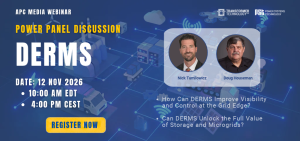





The electrical power industry is currently undergoing a historic transformation, driven by a convergence of aging infrastructure, shifting demand patterns, and the rise of new technologies. We talk with SMEs all the time who agree that this profound change impacts everything from generation and transmission to distribution and the “grid edge”—industrial and commercial facilities, and hospitals. To delve into these critical shifts, we invited three leaders in power systems technology: Mark Paul, Vice President of Global Sales and Marketing at IRISS; Allan Rienstra, CEO of SDT North America and Seth Johnson, President and General Manager of Powerside. Their collective insights reveal the monumental challenges and innovative solutions shaping the future of electrical reliability and safety. To watch the Power Panel, click here.
The Unprecedented Evolution of the Power Industry
The scale of change in the electrical power industry over the last five years is truly unprecedented. This transformation is not merely an incremental shift but a fundamental redefinition of how power is generated, distributed, and consumed.
Transmission lines, substations, transformers, and motors, many designed and installed for a bygone era of consumption, are now being pushed to operate longer and under conditions for which they were never designed.
Aging Infrastructure and Operational Strain
Our panelists agree that a significant factor driving this transformation is the reality of aging power system assets. As Allan Rienstra explains, “transmission lines, substations, transformers, and motors, many designed and installed for a bygone era of consumption, are now being pushed to operate longer and under conditions for which they were never designed. For instance, the average power transformer, from utility grade to those supplying major plants or AI data centers, is between 38 and 42 years old, despite a design life of only 20 years. In the past, transformers were often “overbuilt” to ensure reliability, a practice no longer economically feasible, meaning new transformers will not last as long as their predecessors. The healthcare industry, for example, is already grappling with electrical assets between 20 and 40 years old, which are likely beyond their lifecycle expectancy. The increasing age of these systems significantly raises the potential for critical failures, especially in industries where lives could be immediately at risk, like healthcare.”
Seth Johnson adds that “this situation has shifted the mindset of many consumers and utilities from proactive to reactive.” He recounts a large manufacturing facility that, “facing the inability to quickly obtain replacement equipment— what used to take weeks, now takes years—has allocated a significant budget for spare parts and critical assets like transformers, fundamentally changing their approach to maintenance.”

Facing the inability to quickly obtain replacement equipment—what used to take weeks, now takes years—has allocated a significant budget for spare parts and critical assets like transformers, fundamentally changing their approach to maintenance.
This reactive stance, driven by supply chain constraints, underscores the vulnerability of current systems. Allan Rienstra further illustrates this point with a compelling anecdote: “a cannabis facility, despite being able to see a nearby hydroelectric station, installed three independent natural gas-powered generating stations, demonstrating manufacturers’ increasing need for redundancy due to distrust in traditional grid reliability.”
Shifting Demand Patterns and the Data Center Explosion
Compounding the challenge of aging infrastructure is the drastic shift in power demand. Mark Paul says, “this growth is explosive, not gradual or manageable, describing it as an exponential demand for AI and data centers.”
Allan Rienstra added that, “while the computing load in data centers receives attention, a massive secondary load is required just to cool these facilities. SDT, for example, receives numerous calls related to cooling systems, observing fleets of motors driving cooling fans and pumps running around the clock in challenging high humidity and heat environments. The failure of these cooling systems is not merely an HVAC problem; it directly impacts data operations. The health of these cooling system components is paramount, as technologies like ultrasound condition monitoring can detect earlystage faults before they escalate into costly failures.”
Beyond data centers, general demand for electricity is growing everywhere as people seek to improve their quality of life and add new functionalities. This includes the increasing prevalence of devices requiring charging computers, phones, electric lawn mowers, and trimmers—which have replaced gaspowered tools. Even neighborhood lighting demands more electricity at night. This pervasive growth in demand places immense pressure on an already aging distribution system. The need for power is exemplified by an AI search consuming 1,000 times the power of a typical Google search, which directly correlates with the growing power requirements for data centers.
Power quality issues are worsening as more transients and harmonics enter the grid from distributed, inverter-based resources like wind and solar. Terms like ‘dirty power’ being delivered to AI data centers or manufacturing facilities are now common.
The Dwindling Skilled Workforce and Knowledge Gaps
Another critical challenge is the shortage of skilled trades to maintain these aging assets, a supply that is continually dwindling as older generations retire. Seth Johnson notes that “the expertise required today differs greatly from 30 to 50 years ago, highlighting a significant knowledge gap. This generational shift in both workflow and knowledge necessitates new approaches to asset management. The industry needs technologies that can simplify tasks, allowing less experienced personnel to interpret system conditions.”
Mark Paul elaborated, “the workforce expertise is changing, and this is acceptable because what they need to know is different from what was required before. Simple, intuitive technologies, such as color-changing clips indicating temperature problems, can empower individuals without extensive backgrounds to identify issues.”
The Silent Crisis: Power Quality and its Impacts
One of the most insidious problems exacerbated by these industry changes is power quality. Seth Johnson shared, “power quality issues are worsening as more transients and harmonics enter the grid from distributed, inverter-based resources like wind and solar. Terms like ‘dirty power’ being delivered to AI data centers or manufacturing facilities are now common.”

Power electronics now constitute a significant portion of our load base; for example, every LED light is essentially a switch-mode power supply, introducing its own set of challenges to power quality.
The industry has transitioned to inverter-based resources (IBRs) as significant sources of power generation. Unlike traditional, predictable power generation from high-inertia, large rotating machinery, IBRs rely on power electronics. This includes sources like solar and wind, whose output is dependent on variable factors like solar irradiance and wind speed, making management complex.
Mark Paul points out that “power electronics now constitute a significant portion of our load base; for example, every LED light is essentially a switch-mode power supply, introducing its own set of challenges to power quality.”
Utilities face the immense challenge of maintaining voltage, harmonic distortion, and other critical parameters while balancing diverse power contributors from residential, commercial, and large-scale wind and solar sources. This complexity extends to protection schemes, such as relay protection, which must adapt to a system increasingly reliant on distributed generation.
While continuous monitoring doesn’t necessarily mean sampling data every second, the ability of IoT-installed sensors to gather data daily is incredibly significant, especially for remote data centers where travel is costly.
Real-world Consequences and Economic Pressures
The impact of poor power quality is tangible and costly. Seth Johnson highlights “how utilities have seen transformers go into premature failure because they are not properly sized for inverterbased loads, requiring careful consideration of the K-rating and K-factor of the transformer. While engineers are adept at system modeling, the real challenge arises once the system is installed. There is a constant tension between delivering quality products and being priced competitively, leading to situations where equipment quality may not be as robust as it was decades ago.”
A concerning trend is the compromise on safety features due to cost pressures. Seth Johnson recalls “a project with a renewable group that declined feeder protection in a large 35 kV system because it would increase costs, despite it being a safety concern. The project leaders stated they only needed 95% uptime, seemingly unaware that such a failure could take down the entire substation.” This illustrates a critical reality in the industry today, although Seth expects this approach to shift as renewables become a larger part of the power infrastructure.
Furthermore, the integration of these new resources accelerates the degradation of existing infrastructure. Southern California Edison, for example, determined that every one of their Distributed Energy Resource (DER) substations— converted from step-down to both step-down and step-up functionality—causes the aging of transformers, cables, and all system components twice as fast. This exacerbates the existing problem of aging infrastructure, making proactive management even more critical.
Tools exist to ensure activities are proactive rather than reactive, allowing for more inspections and continuous monitoring. This proactive approach provides valuable information, enabling reactions before a major issue occurs, which is where success and traction are gained.

Revolutionizing Maintenance: From Reactive to Proactive with Data and AI
Given the profound changes in the power industry, the approach to maintenance, monitoring, and inspection is undergoing its own significant revolution. The overarching message from the panel is a decisive shift from reactive to proactive strategies, heavily reliant on advanced data and artificial intelligence.
Mark Paul emphasizes a pivotal change in NFPA 70B, the standard for electrical equipment maintenance. “The 2023 revision clarified that inspections are no longer merely recommendations but requirements—they “shall” happen, a strong legal term ensuring compliance. However, most assets still require only annual inspections, which poses a significant risk as issues can develop and escalate over the other 364 days of the year. This limitation highlights the increasing pressure for continuous monitoring of assets, ideally 24/7.” The good news, according to Mark Paul, is that “this is becoming increasingly cost-effective, with sensor prices falling and modern sensors capable of detecting multiple parameters simultaneously, such as temperature, humidity, ultrasound, and vibration.”
Allan Rienstra reinforces this, noting the shift from periodic to continuous inspections. “While continuous monitoring doesn’t necessarily mean sampling data every second, the ability of IoT-installed sensors to gather data daily is incredibly significant, especially for remote data centers where travel is costly.” This shift, he says, “is not just about how we inspect assets, but a redefinition of why we inspect them, which NFPA 70B now reflects. Maintenance has moved from a reactive approach—responding to alarms—to a condition-based strategy rooted in real-time data.”
Leveraging Data and the Power of AI
The panelists unanimously agree on the importance of data, but with a crucial caveat. Seth Johnson highlights the concept of data ingestion, “While sensors are everywhere providing raw data, the challenge lies in making sense of it. Data is only useful if it leads to tangible, actionable information. This is where the emerging wave of IoT 2.0, driven by AI systems capable of interpreting data, becomes transformative.”
Mark Paul added that “with AI, the need for manual data management diminishes; AI can handle it.”
Seth Johnson elaborates that “to effectively utilize this data, continuous monitoring 365 days a year is essential, not just annual checks. Longterm trending and continuous training of AI systems are the only ways to develop algorithms that provide predictive failure analysis or alarm conditions.”
Allan Rienstra adds that his company, SDT, now “integrates AI models into our products following an acquisition by iCare Group, a dominant player in the IoT space.” He draws a compelling analogy: “if we trust AI for interpreting MRIs and CT scans that impact human lives, we can certainly trust it to assess the health of motors, transformers, or cooling systems.” Crucially, communication is critical for all these assets. As Seth Johnson points out, “a utility cannot realistically operate using 500 different platforms. Therefore, developing APIs and other means to deliver actionable information to a centralized location is essential.”
Simple Technologies Bridging the Gap
Beyond complex AI systems, simpler technologies are playing a vital role in enhancing continuous monitoring and bridging the knowledge gap in the workforce. Mark Paul highlights “color-changing clips that can indicate temperature problems between inspections, providing ongoing feedback on asset health without waiting for failures.” He shared a personal anecdote where his wife, without any extensive training, easily noticed two red indicators on their breaker panel after a power drop, allowing them to diagnose an issue with an air conditioning unit.
Allan Rienstra praises such simple technologies, noting that they don’t require an expert to interpret them, making them perfect for filling the void left by retiring subject matter experts.
Safety
The goal of leveraging these tools and data is to become smarter and more proactive. Mark Paul emphasizes that “tools exist to ensure activities are proactive rather than reactive, allowing for more inspections and continuous monitoring. This proactive approach provides valuable information, enabling reactions before a major issue occurs, which is where success and traction are gained”. Allan Rienstra also underscores this shift to taking predictive technologies seriously, such as infrared, ultrasound, and fluid or oil analysis, as they have become far more critical than in the past.
The critical importance of this proactive shift is evident in safety statistics: the number of reportable incidents related to electrical systems dramatically increases—by roughly a hundredfold—when repairs are done reactively rather than proactively. While working with live power always carries a certain level of risk, especially from arc flash, the risk increases drastically when personnel are forced to rush in and fix a problem on an energized system. The aim is to ensure that proactive, planned maintenance replaces dangerous reactive interventions.
Advanced Technologies and Their Impact
The industry is actively seeking to understand and implement new technologies to adapt to these changes. Each panelist highlighted the advancements in their respective fields, demonstrating how innovation is addressing the complex challenges.
Ultrasound Technology
Allan Rienstra’s company, SDT Ultrasound Solutions, is “hyper-focused on this singular technology, which has many versatile applications. Ultrasound condition monitoring is becoming a go-to tool and will be even more important moving forward. It is one of the few tools that provides the time to act before an interruption occurs, whether at the grid level, substations, or within the crucial cooling systems of hyperscale data centers.” SDT produces ultrasound products globally, and their recent acquisition by iCare Group integrates their ultrasound expertise with IoT capabilities and AI models for early detection of issues like surface or subsurface partial discharge. As Allan Rienstra explains, ultrasound is an extension of our ears, allowing us to detect sounds beyond human hearing.
Infrared Windows and Thermography
IRISS is a global leader in electrical maintenance safety solutions, best known for its infrared windows. These windows are designed to allow visual, infrared, and ultrasound inspections without opening panel doors, adding a critical layer of safety. The company improved these windows with clear polymer materials, enabling larger, custom-sized windows that offer maximum viewing angles without multiple small holes, facilitating safer and more efficient readings. Mark Paul describes thermography as “an extension of our eyes, allowing detection of what we cannot see with the naked eye.”
IRISS’s mission, “humanized safety,” focuses on people, ensuring individuals involved in the electrical space make it home safely at the end of the day.
Power Quality Monitoring and Correction
Seth Johnson’s company, Powerside, specializes in power quality—both monitoring, analysis, and correction. Originally performing power system studies, Powerside evolved into a correction solutions provider, offering power factor correction and harmonic mitigation equipment for various voltage levels. A key advancement came with their merger with Power Standards Labs, a manufacturer of highfidelity Class A power quality monitoring and measurement devices. More recently, Powerside acquired Electrotek Concepts, an agnostic software platform that consolidates data from various power measurement devices and sensors into a centralized platform. Powerside is heavily invested in its software platform, both on-premise and cloud-based, and invests significantly in AI and machine learning to analyze trending data and incident details, training software to accurately diagnose system conditions. This allows them to consult on specific power quality engineering needs for utilities, commercial and industrial entities, and other engineering firms.
Addressing the “Fear of the Unknown” and Prioritizing Safety
New technology often produces fear when people do not understand it. Simplifying these technologies, demonstrating that they are not “black magic” but rather tools designed to monitor and maintain assets more accurately before issues become irreparable.
Ultimately, the goal of these technological advancements is to enhance safety. While big events like arc flashes cause significant damage and potential loss of life, more people die from issues occurring before an arc flash event, such as electric shocks. Detecting smaller problems early, like partial discharge—which typically occurs before an arc flash—is crucial for improving safety. The continued growth of technology aims to simplify and empower, leading to a truly humanized approach to safety.
The power industry stands at a pivotal juncture, grappling with monumental shifts in infrastructure, demand, and workforce dynamics. The insights from Mark Paul, Allan Rienstra, and Seth Johnson underscore the urgent need for comprehensive transformation. The era of reactive maintenance is giving way to a proactive, data-driven paradigm, where continuous monitoring, advanced sensors, and artificial intelligence are no longer luxuries but necessities. Technologies like ultrasound, infrared windows, and sophisticated power quality solutions are becoming indispensable tools for detecting early-stage faults, managing complex distributed energy resources, and ensuring the long-term reliability and safety of critical electrical assets.
The panel collectively conveys a powerful message: by embracing innovation, by diligently listening to what assets are “telling us,” and by prioritizing humanized safety, the industry can navigate this historic transformation successfully.
The ongoing efforts of companies like IRISS, SDT Ultrasound Solutions, and Powerside are making a tangible difference, ensuring that both critical infrastructure and the individuals who maintain it are protected in an increasingly electrified and complex world. The future of power demands not just technological advancement, but a fundamental shift in mindset towards foresight, vigilance, and unwavering commitment to operational excellence and human well-being.

This article was originally published in the September 2025 issue of the Substation Solutions: Design, Automation and Monitoring magazine.
View Magazine


