









For many years, power automation has been improving reliability, safety and operating efficiency for utilities. But the grid is becoming more dynamic, decentralized and harder to manage through traditional practices. Aging infrastructure, electrification, distributed energy resources and more complex power flows mean that local issues can develop quickly and affect the wider system. Moving from a reactive grid to a more proactive one is essential in this evolving environment. Rather than waiting for congestion, voltage problems or faults to occur, utilities need to identify emerging risks early and act before they escalate.
A proactive approach requires better visibility through intelligent equipment, sensors, communications, analytics and workflows that convert field events into actionable information. Technology alone, however, is not enough. To truly innovate, utilities need to break down silos between their operations, engineering, technology providers and equipment suppliers while managing the risk inherent in any operational change.
The experience of Finnish utility VSV Sähköverkko Oy illustrates this approach. Working with G&W Electric and Safegrid, VSV Sähköverkko Oy combined a real operational need, new sensing technology and live-network validation to mitigate risk. The result was not simply a successful sensor deployment, but a collaborative learning process that improved grid visibility and supported a proactive, data driven operating model.
The Utility: VSV Sähköverkko Oy of Finland
VSV Sähköverkko Oy in Southwest Finland operates a 1,400-km-long 20-kV distribution grid, of which more than 500 km is underground cable. It has seven primary substations, and every substation has one or two main transformers and a Petersen coil.
The distribution grids in continental Europe are typically ground isolated to minimize earth (ground) fault currents down to single-digit amperes, increasing power system safety during faults. Additionally, many primary substations are equipped with Petersen coils to compensate for the impact of underground cable capacitances in fault currents. While this method improves reliability, locating faults and correcting complex cases becomes more difficult and time consuming. VSV Sähköverkko Oy was willing to try a new approach—learning as they deployed—to improve operational efficiency and responsiveness.

A Practical, Collaborative Approach
Define the problem and the KPIs – The utility first considered which problem areas and applications might offer the most value in improving power restoration and operational efficiency. They collaborated with their supplier partners G&W Electric and Safegrid to focus on the utility’s traditional fault passage indicators and Peterson coil compensation. Their traditional infrastructure presented several challenges:
- Inability to detect small earth faults that do not send a strong electrical signal
- Manual field identification of precise fault location (possibly buried miles away)
- Further suppression of data by Peterson coil compensation
- Lost data from temporary or intermittent faults not captured by the system, preventing proactive action such as identifying failing components
In addition, the complex, matrix-like structure of European grids also limits possibilities for hierarchical protection enabled by solidly grounded, radial grids.
As part of this up-front discovery work, VSV Sähköverkko Oy and its partners also established appropriate Key Performance Indicators (KPIs) before specific equipment was considered. They considered several qualitative and quantitative KPIs ranging from operational (such as mean time to locate and restore faults) and reliability metrics to financial (staff and contractor time, asset value, customer perception) and organizational metrics (percentage of connected assets, DMS-driven actions and workflows).

Explore solutions, deploy infrastructure – In effect, VSV Sähköverkko Oy had a visibility problem. The utility’s partners worked with them to develop a sensing strategy and explore advanced grid solutions such as smart sensors, cloud and edge analytics, and communication networks to create real-time condition awareness. Partners were key to this stage, because they could share deep knowledge and field insights about a range of equipment and communication options beyond what the utility might receive from internal teams or outside consultants.
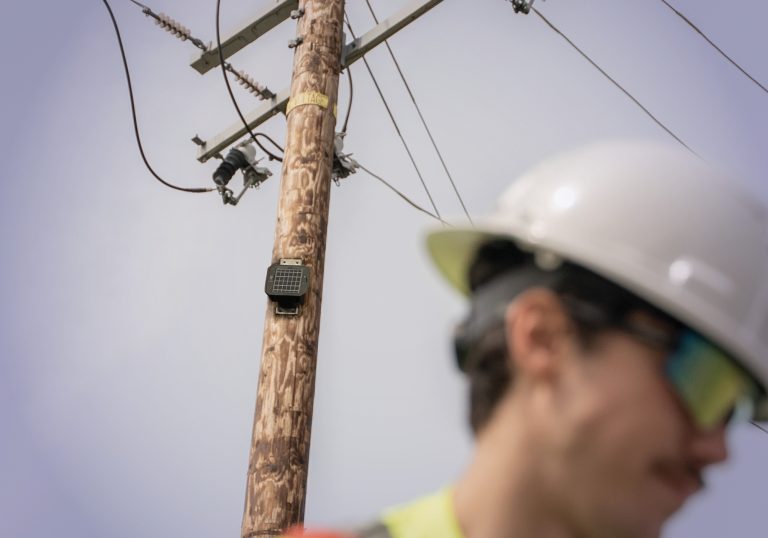
VSV Sähköverkko Oy chose to install IoT wave fault location sensors and cloud connectivity as the best option for locating earth faults quickly and accurately, as even small faults create traveling waves. The system records low-frequency (50 Hz and harmonics) and high-frequency (above 100 kHz) events from sensors detecting anomalies in the grid (high impedance faults, phase-to-phase faults, broken insulators, and aging equipment).
Unlike the methods that rely on current magnitude or impedance, IoT traveling sensors capture wave arrival time to pinpoint the affected cable section with nanosecond speed and precision. When a fault occurs, it creates a sudden electrical disturbance, or traveling wave, that moves along the transmission line at nearly the speed of light. Unlike many conventional electrical measurements, it is not affected by temperature changes, nearby transmission lines, or other operating conditions, making it a highly reliable indicator of fault location.
Ultimately, the utility installed 100+ sensors, scaling their initial solution so that it covers 85% of their grid for true institutional innovation.
Map and build the data journey – A scalable data pipeline from geographically dispersed assets is a hallmark of grid innovation. VSV Sähköverkko Oy needed to determine the volume and type of data their new data acquisition capability would require. While modern SCADA control systems can monitor field data from collection points, newer sensor technology enables more detailed, higher frequency data measurement and real-time voltage intelligence. OEMs and other partners can help answer questions such as: how does high-speed data leave the sensor and feed into the system? What are the integration pathways and interfaces? Where will it be safely stored? What analytic insights and patterns can we expect?
For their grid upgrade, it meant processing data with locale edge processors at the substation and using cellular communications to stream synchronized, time-stamped data to a central cloud platform. The data insights are directly delivered into operational workflows: When the cloud server detects a fault, it sends the location and fault information to the Distribution Management System (DMS) map, optionally alerts the operator with a message, and displays the exact fault location on the traveling wave fault location system map view. The same system can convert ongoing raw measurements into actionable information, creating an end-to-end data pathway from sensor to decisionmaker for higher operational performance.
Validate and calibrate – In Finland, it is common to verify earth fault protection settings by running earth fault tests in a live network. Grid innovation is proven in the field, not in presentations or labs. The utility’s willingness to run live line testing, and work together with its partners in the field, was critical to their success. The existence of underground cable networks, natural environments, and high reliability expectations made the testing especially critical.
VSV Sähköverkko Oy used resistor banks from 0 Ω up to 40 kΩ to limit the fault current. A test fault, switched by a circuit breaker, creates a clean and stable fault resistance usable for level calibration but does not represent a typical real-life fault case. So, the utility also developed a simple remote-controlled arm to better simulate natural fault conditions and challenge the traveling wave fault location system for events such as faults caused by tree twigs on lines. They also ran spark-gap tests, which can simulate certain PD-like conditions when combined with small value capacitors.
The testing shows that innovation is about more than “set it and forget it” equipment installation. It ensures a fully data-driven operating model and continuous improvement that make an automated system smarter over time.

Measure outcomes – What does success look like for utilities that adopt grid innovations? Any enterprise-wide innovation strategy and investment should be anchored in standards-driven metrics and key performance indicators. In the U.S., the following reliability indices provide the guideposts and proof to manage customer perceptions and build support:
SAIDI (duration): 60-120 min/year (∼112 hr)
SAIFI (frequency): 1.0-1.5 interruptions/customer/year
CAIDI (time to restore service): 60-80 min/interruption
MAIFI (short duration interruptions): 1-3 per customer/year, typically > 5 minutes
According to the U.S. Department of Energy, studies tracking Fault Location, Isolation and Service Restoration, which rely on advanced, time-synchronized sensors, demonstrate up to a 50% reduction in System Average Interruption Duration Index (SAIDI). Utilities can move from narrowing a fault to a 6-mile radius on a 180-mile line under traditional impedance-based methods—miles of uncertainty—to pinpointing faults within 300 meters.
Achieving Long-Term Success and ROI
IoT traveling wave sensors on a distribution grid, combined with cloud computing, can predict and more quickly locate faults, while continuing to learn from actual fault events.
Because of these and many other financial benefits, utilities like VSV Sähköverkko Oy are seeing that grid innovation is a worthwhile investment, especially when they don’t have to navigate risk or develop solutions in the dark. OEMs and their partners can be part of dedicated cross-functional innovation teams that prioritize collaboration, transparency and field validation. This approach, combined with the right technology, ensures a successful transformation from reactive fault response to proactive grid management.

Nenad Uzelac is a senior innovation director at G&W Electric. He received his MSEE in 1995 in Serbia and MS in Design & Development in 2004 in Chicago. Uzelac has served as the past chairman of CIGRE A3 “Transmission and Distribution” Equipment Study Committee and a liaison between CIGRE and IEEE PES Technical Councils. Additionally, he has held various functions in IEEE Switchgear Committee and is the current chair of ER&P subcommittee. Research interests include switching technologies, internal arc studies, condition assessment and low power instrument transformers.

This article was originally published in the October 2026 issue of the Next-Gen Infrastructure & the Digital Grid magazine.
View Magazine